QVC Easy Pay and HSN FlexPay Explained: Is 0% Really 0%? (Total-Cost Math)
We are not affiliated with QVC, HSN or ShopHQ.
Quick answer — Easy Pay splits the price into five equal monthly charges on one card. A $199.98 vacuum on September 7, 2026 ran as five payments of $40.00. HSN's FlexPay offered two of $30.00, three of $20.00, four of $15.00 or five of $12.00 on a $59.99 item, and cardholder ExtraFlex added six of $10.00.
Both networks sell instalments as a headline feature, and both are genuinely interest free. The interesting question is not the interest rate — it is what the plan does and does not cover.
How does QVC Easy Pay work?
Easy Pay divides the item price into equal instalments charged to the same card over consecutive months. Five payments is the common configuration, though some categories run more.
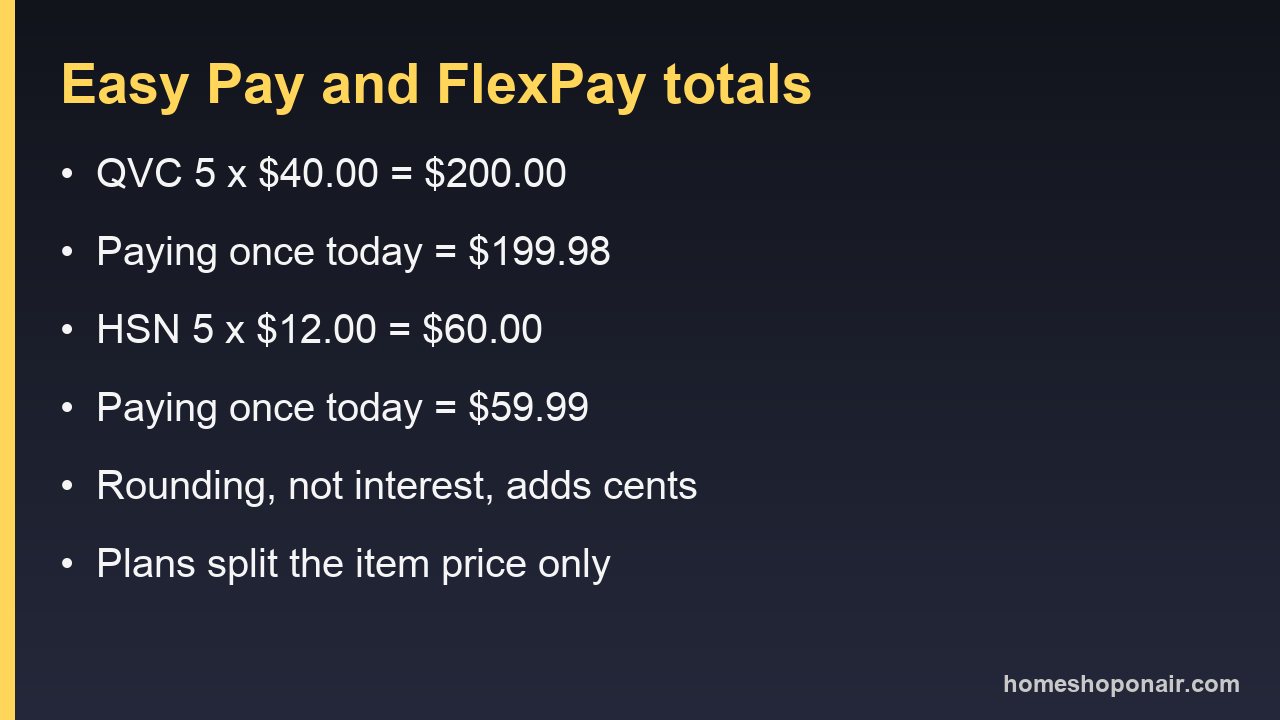
Take a real example. A $199.98 vacuum on September 7, 2026 was offered as five Easy Pays of $40.00, so the plan total came to $200.00 — two cents above the one-time price.
How does HSN FlexPay differ?
FlexPay is the same idea with a wider menu. On a $59.99 item that morning, HSN offered a single payment, two of $30.00, three of $20.00, four of $15.00 or five of $12.00.
Cardholders get one more rung. ExtraFlex, available with the HSN Card or QCard, added a six-payment option of $10.00, which also totals $60.00.
Is 0% really 0%?
Yes on interest, with a rounding footnote. Five payments of $12.00 add up to $60.00 against a $59.99 price, and five of $40.00 add up to $200.00 against $199.98.
The extra cent or two is arithmetic, not a fee — the instalment is rounded to a clean figure and the total lands slightly above. Nobody is going to be ruined by two cents, but it does mean the phrase "the same price, spread out" is not exactly right.
What does the instalment figure leave out?
This is the part worth reading twice. The plan splits the item price, not the delivered total.
On the September 7 HSN deal, the FlexPay lines totalled $60.00 while shipping and handling was quoted separately at $5.50, making the real outlay $65.49. QVC's vacuum shipped free that day, so the split matched the delivered total — but that is a property of the offer, not of Easy Pay.
Tax is the other omission. Sales tax varies by state and is applied at checkout, so no instalment figure on a product page is the final number.
Does an instalment plan affect your credit?
These are not loans in the buy-now-pay-later sense, and there is no application. The charges recur against a card you have already provided, which is why a failed payment is a card problem rather than a lending decision.
The practical risk is different: an expired or replaced card mid-plan can leave payments failing quietly. If you change cards, both networks have account areas for updating an active plan.
When is an instalment plan actually worth it?
It is worth it when the alternative is a revolving balance. Splitting a $600 mattress across five months at zero cost beats carrying it on a card at twenty-something percent, and that is a real saving rather than a marketing line.
It is not worth much on a $59.99 purifier. Five payments of twelve dollars mostly buys you five chances to forget the charge is coming, and the arithmetic gain over paying once is one cent in the wrong direction.
Which network's plan is more flexible?
HSN wins on choice. Its ladder ran from one payment to five on a $59.99 item, with a sixth rung for cardholders, so you can pick the instalment size that fits rather than accepting the one on offer.
QVC's plan is simpler and, on bigger tickets, more useful. Five payments of $40.00 on a $200 vacuum is a real cash-flow tool; five payments of $12.00 on a purifier is mostly ceremony.
How do you compare an instalment offer against a rival retailer?
Convert everything to one delivered number before you compare. Item price, plus shipping, plus the network's return-shipping deduction if you think you might send it back.
Then compare that against the rival's delivered price on the same day. We do this in every price table on the price-check hub, and the September 7 examples are worked through in the QVC TSV write-up and the HSN Today's Special write-up.
Two background pieces fill in the rest. The TSV explainer covers how the daily badge is priced, and the returns math covers what comes off a refund. If you want to see which network's deal format wins more often, that is the head-to-head, and today's on-air blocks are on the schedule page.
FAQ
Is there interest on Easy Pay or FlexPay? No interest is charged on the standard plans. Rounding can leave the instalment total a cent or two above the one-time price.
Can I pay off a plan early? Both networks handle active plans through your account area, where remaining payments can be settled. Terms vary by order, so check the plan itself.
Does shipping get split too? The instalment figures shown on the product page cover the item price. Shipping and handling is quoted separately, and tax is added at checkout.
What happens if a payment fails? The charge retries against the card on file, and the account area will flag it. Update the card rather than waiting for the network to contact you.
Is ExtraFlex available to everyone? No. The six-payment option required the HSN Card or QCard on the offer we checked.
Easy Pay shrinks the monthly number, which is exactly why the full price deserves a look first. Four checks that take a minute will tell you whether a sale price is real. And when the TSV is leggings or pants, sizing is the other trap: what to do when you are between two sizes.
Sources
- QVC — item V96770, Easy Pay terms as shown (read 5:50 a.m. ET, September 7, 2026)
- HSN — Today's Special, FlexPay and ExtraFlex options as shown (read 6:10 a.m. ET, September 7, 2026)
- Shark Tank Season 18: Premiere Date, Sharks, How to Watch and How the Deals Work
- QVC Return Policy 2026: Shipping, Returns and Restocking Fine Print at QVC and HSN
- HSN Today's Special vs QVC TSV: Which Daily Deal Is Actually Cheaper?
- QVC Today's Special Value Explained: How TSV Works, When It Changes, and How to Check the Price History